In short
I started as a graphic designer in 2003. I spent more than seven years in marketing and ran my own studio, until I moved to France in 2009 and became a front-end developer.
I have worked in startups as a product designer since 2013, in B2C and B2B. Depending on the project I have also been the front-end developer, the UI designer, the researcher, the illustrator, the visual designer, the project manager, or the product lead.
The teams have been in Mexico, the USA, Canada, Brazil, England, Spain, and France. The industries include real estate, auction houses, government, restaurants, beauty, music, hospitality, food, football, nightclubs, editorial design, photography, and education.
Designer by accident
I finished a graphic design degree in 2001. I got there by accident. In 1997 a friend told me the career had just opened in my town. I trusted her and spent my savings on the enrollment without knowing what the work could be. It is the best leap I have made. She left the school. I stayed.
I sat in workshops with Luis Almeida, Félix Beltrán, and Antonio Pérez Iragorri.
Early work
In the early 2000s the internet was limited and there were no shared tools, so printing, vendors, and running the service were part of delivering the work.
In 2006 I opened a design studio. Several clients were former bosses. The work covered political campaigns, nightclubs, pubs, government agencies, restaurants, NGOs, retailers, and schools. I made identities and stationery, illustration, interiors for nightclubs, ads for radio, press, flyers, and posters, helped run events, handled print, made Flash and 3D Max animations, edited video, and designed publications and websites.
Websites
I designed and built websites from 2005 to 2014. I sold the first one in 2005 without knowing HTML or CSS. I wanted to make websites, so I started.
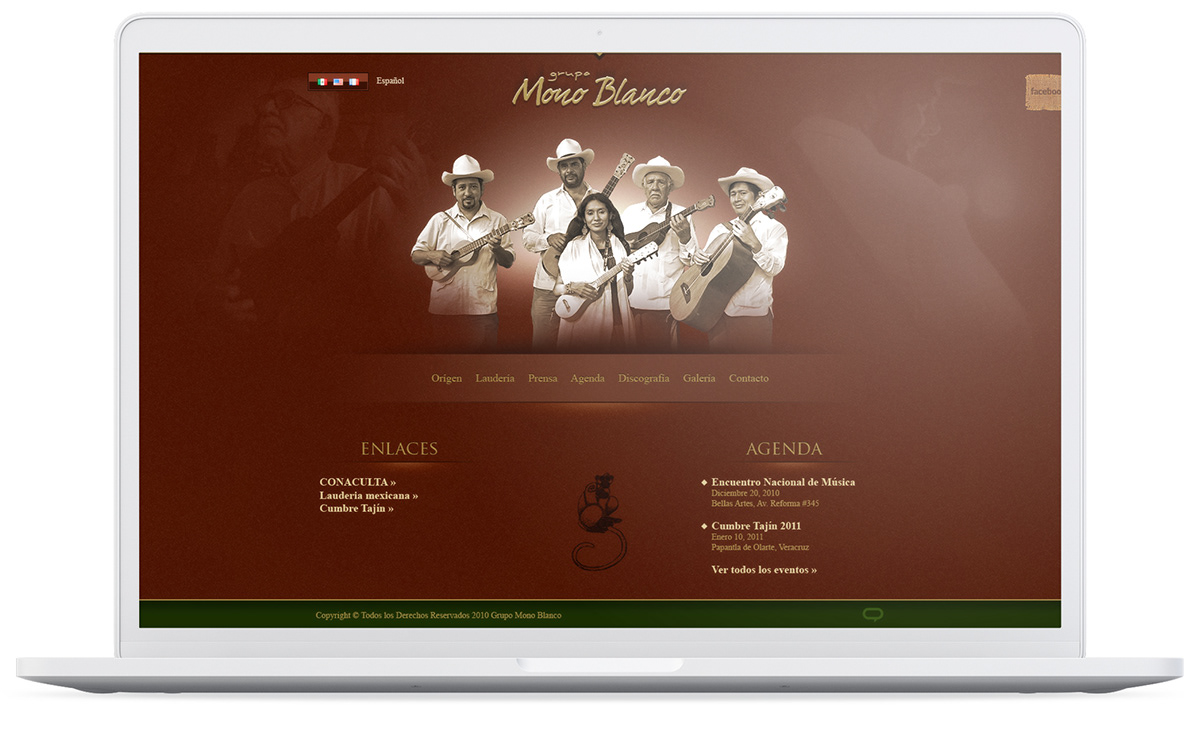
The early sites were Dreamweaver and Flash, with animation and audio on almost every screen. Later I built front-end themes for WordPress, for clients in Mexico, Spain, and the USA. Mono Blanco's site in 2007 used Flash, PHP, HTML, CSS, and JavaScript.
Product design
In 2013 I joined startups as a front-end developer. I turned designs into pages and, when nobody else was doing it, drew the UI in Photoshop and Illustrator. I had not heard of Sketch yet. I started using it the next year.
I joined PlayerPro as a graphic designer and ended up on the UI, the interviews, the stakeholders, the video, the prototypes, and the strategy. I was doing UX and calling it "whatever the delivery needs." After that I went to workshops, read, and followed the field on purpose.
The losses
I would rather write about the losses. I am not ashamed of them. Knowing them, and how not to repeat them, is part of the job.
There was a stretch when I felt nothing about the work. I had no motivation, and I was afraid to speak in public. I was in a Canadian startup, on a multicultural team, with impostor syndrome. Burnout was already there and I did not see it. This was during the COVID lockdown. My behavior no longer matched the company. After almost four years I was fired. It hurt, and I needed it.
I spent the following months studying, listening, and writing down what I wanted before I took another role.
The next job was a hospitality startup. My boss quit the week after I arrived. I took his responsibilities and did not argue about the title. Months later the project manager quit and the team had nobody leading it. I took that too. Three roles, one salary. I asked for a raise more than once. When it was clear that would not happen, I also understood that doing too much was its own problem.
What I tell the team
Finding a line between the job and the rest of life is something I talk about with colleagues. A few things have held up for me:
- Say what you want, check what the other person already knows, and pick the simplest way to say it.
- Respect other people's time. Some ceremonies can be a Slack message.
- Teach, learn, share, and listen. At work, and outside it when you can.
- Keep the discipline on days off too. Take them without guilt.
- If you are sick, you cannot help your partner, your family, or your friends. Sleep, eat, move, drink water, and leave room for fun.